



How Much Protection Do Ski Helmets Offer?
16th December 2025
Last modified on December 18th, 2025
Not as much as some might think according to a new Swiss study. They offer limited protection. Helmet use is widespread with Italy making it compulsory this season. UPDATED
The study was conducted by the Swiss public broadcasting channel, Radio Télévision Suisse, RTS.
Researchers collected 16 models of helmets from various brands, including Oakley, Uvex, Atomic, Head, Salomon, Albright, Giro, POC, and Wedze.
All meet the European standards for protection against impacts of speeds up to 12.4mph (20km/h).
An analysis of skiers and snowboarders carried out between 2019 and 2023, however, revealed that skiers and snowboarders typically travel faster than that, with 75% of skiers descending slopes at more than 31mph (50km/h).
18% of people will go as fast as 46.6mph (75km/h).
“None of the helmets tested — models from Oakley, Uvex, Atomic, Head, Salomon, Albright, Giro, POC, and Wedze — can withstand these speeds.”
Specifically, the models were tested for impacts against an obstacle or a collision between two skiers descending at 35 km/h.
One researcher involved pointed out that a collision at 50 km/h, in which the brain reaches 2400 G, “could be lethal.”
One proposed solution coming out of the study is to revise the standards given to manufacturers.
It is acknowledged there are limitations to what those manufacturers can accomplish when measured against the higher speeds everyday skiers and snowboarders are reaching.
“I don’t think we’ll be able to make helmets that are effective up to 50 km/h, but we could do much better than 20 km/h,” said Professor Dominique Pioletti at the Laboratory of Biomechanics in Orthopedics.
“The big problem with the standards is that they test linear accelerations, and that’s not the most dangerous for the brain.
“The most dangerous is an impact that induces head rotation.”
Professor Pioletti questions the usefulness of the MIPS rotational impact protection system, indicated by a sticker on many helmets.
“Having the little yellow or orange sticker doesn’t mean the helmet is good,” he said.
It is widely believed helmets are effective for glancing blows and at slower speeds but the new survey seems to conclude there is room for improvement in design.
It also seems skiers and snowboarders should be more aware of the actual and real protection helmets offer.
See here for the full report on RTA.
Update:
There has been some reaction over on The PlanetSKI Facebook page – feel free to add your view:
John Cooper – I needed my helmet for the first time ever last season when I was taken out from behind in Tignes. I was skiing slowly on an easy slope when someone skied into me spun me round and I landed on my back. Didn’t think I’d hit my head but later in the accommodation realised I was concussed. The following day I discovered a big split in the shell of my Sweet Protection helmet. Have to assume it would have been a lot worse without it.
Nicolas McMillan – I had to go without my helmet for 2 days last week , being middle aged I skied the first 30 years without and the last 10 with. Going without again I instantly felt more vulnerable but it also made me more careful. Helmets clearly give a misplaced feeling of invulnerability and have increased the willingness for everyone to go crazy fast on the slopes. We might actually be better off without them!
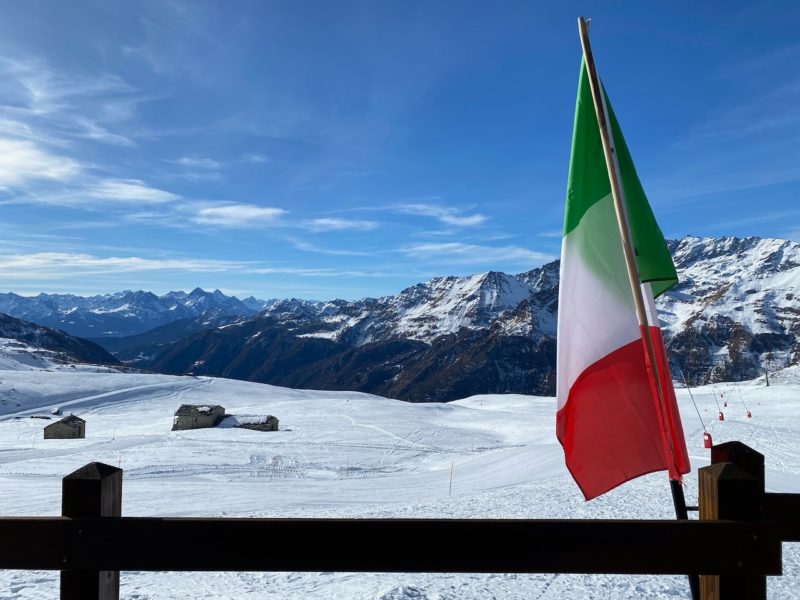
This winter Italy has made helmets compulsory across its ski resorts:

PlanetSKI’s Jane Peel and James Cove in Pila, Italy. Photo © PlanetSKI

PlanetSKI: Number 1 for digital ski news
Your digital platform for ski news, resort information, travel, equipment rental, sport, money saving deals and everything connected with snowsports – web site, social media & more.