



Johan Eliasch Ousted as President of FIS with Alexander Ospelt Replacing Him
11th June 2026
In a bitter election that has split the organisation down the middle Johan Eliasch has been ousted. It was the narrowest of margins: 65 to 64. UPDATED
The International Ski & Snowboard Federation runs elite snowsport competition across the globe and the very future of the organisation has been, and remains, at stake.
On the one side was the Swedish-British billionaire, Johan Eliasch, who has run the organisation since 2021.
On the other side was most of the major ski nations whose feathers has he ruffled – to put it mildly.
The new president is Alexander Ospelt, a lawyer from Lichtenstein and he was supported by the major nations – Switzerland, Austria, Germany, Italy, Sweden, the USA, Canada, France and Norway.
He is a former head of his country’s ski federation and member of council.
The decision was made at the 57th FIS Congress in Belgrade, Serbia.
“There’s been some great dialogue in the build-up to this Congress and it’s been very interesting to talk to representatives from all different countries, but the result [65 votes to 64] shows we’re still divided,” said President Ospelt.
“I see this division as a chance, rather than a problem.
“My first task will be bringing unity and a common ambition to drive FIS forward together.”
Ospelt is not an outsider to FIS, but as an internal alternative to the current rift between the presidency and several of the main federations.
The agenda was changed on an 88% vote to bring the presidential election forward as the first item of business.
Then there was a 60% vote to use paper ballots instead of electronic voting, which seemed to reflect some mistrust in the FIS administration.
In his concession speech Eliasch aimed an allegation at the Olympic body and urged FIS to protect its independence before congratulating Ospelt.
“The IOC tried to influence the outcome of today’s vote. Against this we must stay firm,” Eliasch said.
“It’s been a great privilege to serve you,” said the outgoing president, who had said the election would be a win-win as he could “get my life back” if he lost.
“Either way I am very happy.”
He argued that FIS should not abandon what had been built during his time in office.
“It would be a great shame to give that up.
“It is very important that everyone works together and aims high.”
The International Olympic Committee congratulated Ospelt without directly addressing Eliasch’s claim of interference.
“We thank Mr. Johan Eliasch for his work as FIS president and IOC membe,” said the IOC.
Eliasch also loses his membership of the International Olympic Committee.

Johan Eliasch. Image c/o FIS
Ski athletes including Marco Odermatt and Mikaela Shiffrin had voiced concerns about how FIS had been run under Eliasch ahead of the election.
“We have to say that not much has gone forward in recent years. I have also learned from insiders that the FIS has developed anything but positively in terms of finances. And that’s why there’s not much left but to make a change at the top of the FIS,” said overall World Cup winner Marco Odermatt.
“Many of us athletes feel that the FIS and the current leadership have shown a significant lack of transparency,” said Mikaela Shiffrin.
President Ospelt has underlined his intention to listen to the National Ski Associations and to athletes, to get a deeper understanding of the issues they are experiencing.
“There’s a lot of work to do, but I want every NSA to feel like now is a new start, that I will take all their concerns seriously and that every NSA must be treated with the same importance as any other.”
“I’ve requested that the bigger states show solidarity with the smaller states – it’s not in anybody’s best interest to just have athletes from the leading nations competing in the World Cup – and the bigger states are committed to that,” added Ospelt.
“We’re already looking at ways to gain additional stakeholders, investment and sponsors, in order to distribute more income to the NSAs and meet athletes’ requests for increased prize money,” said Ospelt, when quizzed on further areas of action.
“For me, it makes most sense to strengthen the disciplines where each of their audiences are.
“Taking China as an example, it makes most sense to take Freestyle and Snowboard Alpine events there, as the great athletes they have [in those disciplines] can enable us to put on showpiece events – showpieces we can use to broaden the interest across the whole of Asia.”
We reproduce more from his post election news conference lower down this article.
Last week the CEO of the organisation, Urs Lehmann, resigned citing concern over the organisations finance, much of the background is in the earlier PlanetSKI articles.
- Urs Lehmann resigns as CEO of FIS
- FIS president under attack with questions raised about finances and leadership
Initially there were five candidates in the race:
- Johan Eliasch (GEO)
- Anna Harboe Falkenberg (DEN)
- Victoria Gosling (GBR)
- Alexander Ospelt (LIE)
- Dexter Paine (USA)
Anna Harboe Falkenberg, Dexter Paine and Victoria Gosling all withdrew in the days leading up to congress.
It left a two-horse race between Johan Eliasch and Alexander Ospelt.
The support of the smaller federations was a key factor for Eliasch, but though he gained strong backing he fell just short.
Alexander Ospelt has promised to restore normal relations within FIS and heal divisions.
He speaks of “building bridges” between large and small associations, athletes, sponsors, the media and fans.
He calls for FIS to be “open and transparent”.
He now has a massive re-building job to do in an organisation that is deeply divided.
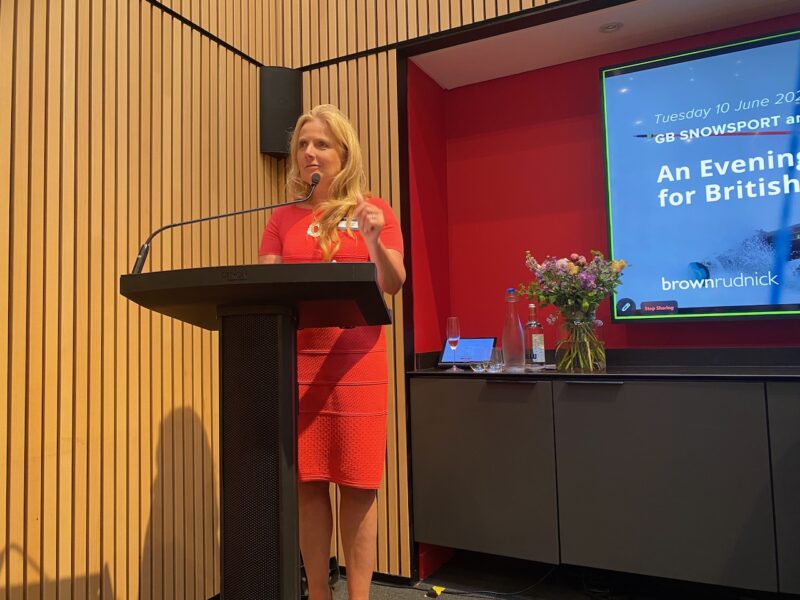
GB Snowsport has reacted to the result and the election of the GB Snowsport Chief Executive, Victoria Gosling OBE, to the FIS Council.
It’s the first time Britain’s National Ski Association has held an elected role on the FIS Council and gives GB a voice at the top table.
View this post on Instagram
“I’m honoured to have been elected to the FIS Council today, and am very grateful to everyone who cast a vote in support of my candidacy today, as well as to my GB Snowsport colleagues for their support throughout the election process,” said Vicky Gosling.
“To become the first British representative nominated to Council in FIS history is humbling, and I am aware of the significant responsibility that I hold in that regard.
“Throughout recent weeks, the FIS family has shown that it is unafraid to have the robust and necessary conversations that we need to have for the long-term health of the sport, and I look forward to continuing those discussions in the coming months and years.
“As a snowsport nation, Britain has been on a significant journey in recent years.
“It has not always been easy, but I believe that today shows the high regard that we are held in within the snowsport community.
“We have much to look forward to as a sport, and I am committed to putting the interests of our sport first from within the FIS Council.”
Vicky Gosling, CEO GB Snowsport. Image © PlanetSKI
See more of the remarks from Alexander Ospelt after narrowly securing victory:
“I’ve been to the Engadina [ski marathon] many times and there are over 12,000 people participating in it, so I always wondered, ‘why not combine it with a World Cup Cross-Country race?’ as we’d already have the audience there and it’d be even more attractive to sponsors.”
“We can also learn from organizers of big Ski Jumping events like the Four Hills Tournament, sharing good ideas across venues and across disciplines.
“I think the fact that we’ve got so many disciplines is an opportunity for us.
“With Alpine, there are lots of discussions going on about how to make it more attractive,” said Ospelt, who was asked about the prospects of Freeride becoming an Olympic discipline and how to strengthen Alpine’s media appeal.
“We need to find the right TV format and I think we need to make the athletes more visible, work on promoting them more and turning them into stars – which is what audiences want to see.”
“Freeride is really cool too, it’s a totally challenging competition in every way, which is what you want to see, and it’s very fun and very attractive for spectators – especially TV audiences,” he said.
“But before [fighting for Freeride to get in], the first step is to fight for Snowboard Alpine and Nordic Combined to stay in the Olympics. If we achieve that, we can move on to other disciplines.”
We will be updating this article with further reaction and analysis.
Do check back on what has been an historic day for the International Ski & Snowboard Federation and set the direction for the coming years.
PlanetSKI: Number 1 for digital ski news
Your digital platform for ski news, resort information, travel, equipment rental, sport, money saving deals and everything connected with snowsports – web site, social media & more.