





Glacier Extinction Map is Launched
26th September 2026
The Global Glacier Extinction Explorer is a new interactive website that predicts the future of glaciers across the world. NEW
The platform builds on a recent study published in Nature Climate Change, led by researchers from ETH Zurich and Vrije Universiteit Brussel together with an international research team.
The study provides the first global assessment of the disappearance of individual glaciers and indicated that the world is approaching a period of unprecedented glacier melt.
It translates scientific projections into an accessible interactive map.
“Global numbers such as glacier mass or area loss can feel very abstract,” said co-lead author Kristof Van Tricht from VITO Remote Sensing.
“With this website, people can zoom into their own valley or mountain region and see what different levels of global warming could mean for the glaciers they know.
“We hope it can also help local communities prepare for a future with fewer glaciers.”
The launch comes at another difficult moment for European glaciers.
2026 is once again proving to be a particularly bad year for glaciers in the European Alps.
Final end-of-summer measurements are still ongoing, but preliminary observations suggest that 2026 could become one of the worst years for Alpine glaciers since systematic measurements began.
A combination of low winter snow accumulation and several summer heat waves has resulted in substantial ice loss across the Alps.
For the smallest glaciers, another extreme melt season can be enough to push them beyond the threshold of survival.
“The disappearance of a glacier is not the result of a single warm summer, but the culmination of decades of cumulative mass loss,” said co-author, Harry Zekollari.
“Year after year, insufficient snowfall and strong summer melt gradually reduce a glacier until it can no longer sustain itself.
“Extreme melt years such as 2022 or 2026 can, however, accelerate this final stage.”
The scientists predict that nearly half of the world’s glaciers could disappear by 2100 if global warming remains at +1.5°C.

Vanishing glaciers. Image c/o Global Glacier Extinction Explorer
Glaciers shape landscapes and ecosystems, contribute to water resources and tourism, and often have strong cultural and emotional significance for local communities.
The new website therefore brings global projections back to the scale at which glacier loss is ultimately experienced: the individual glacier.
See more here: www.glacierextinction.com,
The map also allows users to toggle between different temperatures — 1.5°C, 2°C, 2.7°C, or 4°C of warming — and the colour of the dots on each glacier reveals its predicted fate.
Dark red indicates the glacier is already extinct, orange means it will become extinct between 2027 and 2041 and light blue means the glacier is expected to survive through 2100.
Related PlanetSKI Articles:
- Fresh Warnings of Glacier Collapses as Climate Change Makes Mountains Unstable
- Alps set to lose record number of glaciers in next decade
- Italian glacier melt continues
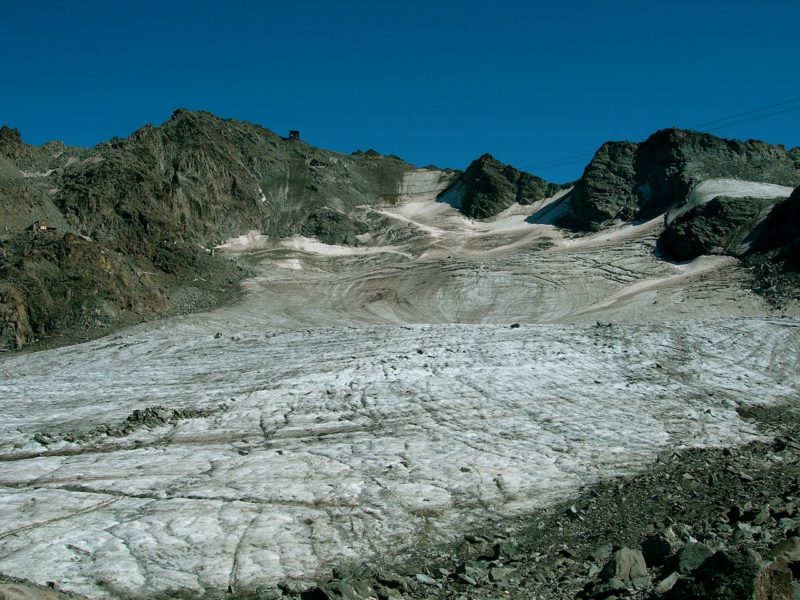
Mont Fort glacier, Verbier. Image © PlanetSKI
Separately a new international study has measured how much water has melted from glaciers in Antarctica and Greenland since the 1970s.
It’s enough to fill four and a half billion Olympic sized swimming pools.
The researchers say it’s the most complete picture of ice loss from those regions ever done.
Heidi Petracek reports for Global News:
Meanwhile a natural wool covering placed over 200 square metres of high-altitude Alpine ice in Switzerland has proved effective at slowing summer melting.
Normally conventional synthetic tarpaulins are used and the sheep’s wool offers a biodegradable alternative to plastic sheets.
Initial results from the “Keep It Wool” trial on the Tsanfleuron Glacier in western Switzerland show that prototype wool blankets protected snow and ice from heat about as well as plastic geotextiles.
According to a recent report on the reuters news agency researchers found that the covers significantly slowed ice loss during the warmer summer months.
However, project organisers and glaciologists stress that physical covers can only protect very small areas.
Just about 0.02%t of Switzerland’s total glacier surface is currently covered with protective materials.
This means the method is mainly useful for protecting small ski areas or vulnerable infrastructure, rather than providing a wider solution to global warming.
PlanetSKI: Number 1 for digital ski news
Your digital platform for ski news, resort information, travel, equipment rental, sport, money saving deals and everything connected with snowsports – web site, social media & more.