





Monitoring Rock Falls in the Alps
29th May 2025
The destruction of the village of Blatten in the Swiss Alps by a huge landslide has highlighted the threat posed by climate change as the mountains become more unstable. NEW
The Alps are appearing to become more unstable as global warming impacts.
The temperatures in the Alps are rising twice as much as the global average with an apparent increasing number of rock slides.
There are some fears that the situation may only get worse.
The average temperature in the Alps has risen by almost 3°C compared to pre-industrial levels.
We have reported on the partial collapse this week of the Birch glacier above Blatten that triggered a huge landslide that hit the evacuated village.
90% of the village is destroyed with the village buried under rocks, ice and mud.
There have been similar incidents in recent years.

Marmolada ice collapse. Image c/o Alpine rescue services.
Predicting such events is a complex affair that involves understanding climate change as well as numerous other factors that can influence the movement of mountains.
There have always been areas of instability in the Swiss Alps, says natural hazards expert, Federico Ferrario.
This is due to geological and hydrogeological conditions, as well as other weather effects.
“With climate change, these instabilities are becoming increasingly relevant even at high altitudes,” added Ferrario.
Glaciers and permafrost – called the “glue” of the Alps – are melting as temperatures rise, destabilising slopes.
The risk of collapse increases.
Ferrario was quoted in a recent article posted on Swiss Info
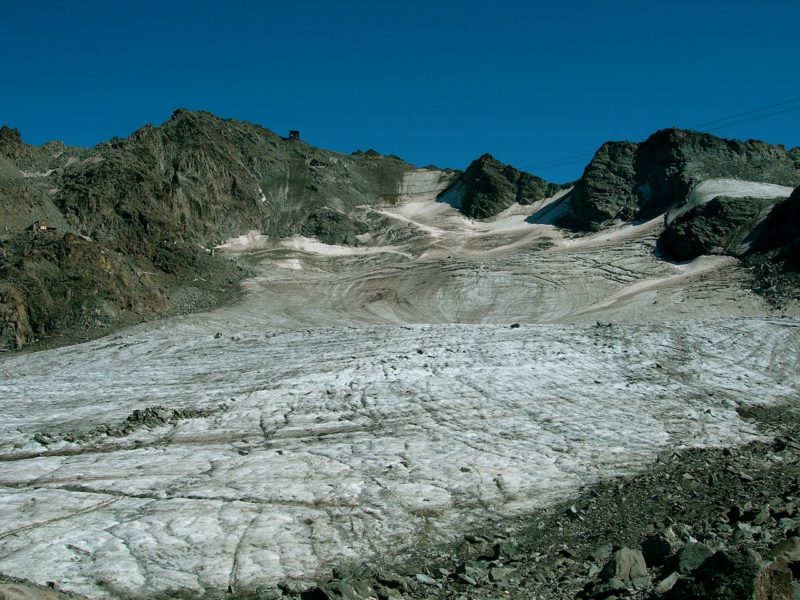
Mont Fort glacier, Verbier. Image © PlanetSKI
The authorities are now becoming increasingly concerned about a problem that may just be beginning.
However, an analysis of scientific literature from the past 30 years by the Swiss Institute for Snow and Avalanche research, WSL, shows there are still many uncertainties about the precise reasons for collapses in the mountains.
See here for the full details of the WSL research.
A provable link to climate warming exists only for rockfalls, where individual rocks with a diameter of less than 50cms come off the mountains.
Quantifying the impact of climate change on landslides and other mass mountain movements remains difficult because of nature’s complexities as well as limits in available data and existing statistical processing techniques, according to the WSL.
For small landslides, on the order of 100 to 1,000 cubic metres of material, there is a clear link to climate change, says Mylène Jacquemart, co-author of the WSL study.
“They are happening more often, especially at high altitudes,” she says.
Switzerland is a pioneer in monitoring the Alps, says Yves Bühler, an expert on monitoring devices at the Swiss Institute for Snow and Avalanche Research.
“In Switzerland there is a unique collaboration between the authorities who have to make decisions, private companies that have developed and offer high-tech monitoring systems, and researchers who test and validate new devices,” Bühler said to Swiss public television, SRF.
There are various ways to monitor the situation:
- Satellite images
- Radar devices
- Sensors in the ground
If there is a concern the authorities can issue an alert.
In the Alps, it is very difficult to predict which point will collapse next, said Mylène Jacquemart.
“People living in the mountains and satellite data can provide valuable information. But it’s impossible to monitor every rock face in Switzerland,” she said.
Increasing research and observations will be required across the Alps.
The future will involve understand the geological changes taking place and learning to live with the risk of natural hazards or leaving areas that are most at risk.
x
PlanetSKI: Number 1 for digital ski news
Your digital platform for ski news, resort information, travel, equipment rental, sport, money saving deals and everything connected with snowsports – web site, social media & more.