


Europe’s Heatwave Hits Alpine Glaciers Hard
22nd June 2026
Last modified on June 29th, 2026
The glacier resorts that have some slopes open are suffering in the heatwave with summer glacier melt accelerating. Some resorts are promoting themselves as the place to come to cool down. UPDATED
It is the second heatwave to hit the Alps so far this summer with more predicted.
The daytime freezing level is currently over 4,500m in the Alps.
The French resort of Tignes opened its Grande Motte glacier for summer skiing and snowboarding on June 20th and it is suffering.
The resort claims a snow depth of 100cm on the glacier, but some is melting in the current heatwave.
The glacier itself is 40m thick but it is feared this may all have gone in the next decade.
According to Clément Colin, CEO of Altta, the new company managing the ski lifts in Tignes, “in ten years, the glacier will have almost completely melted.”
The Bossons Glacier by Chamonix is showing fresh signs of retreat.
New aerial images reveal extensive ice loss across the glacier, which descends from the Mont Blanc Massif.
Meltwater streams can be seen flowing from the ice, while a large hole that emerged in the glacier’s lower tongue in 2025 remains visible.
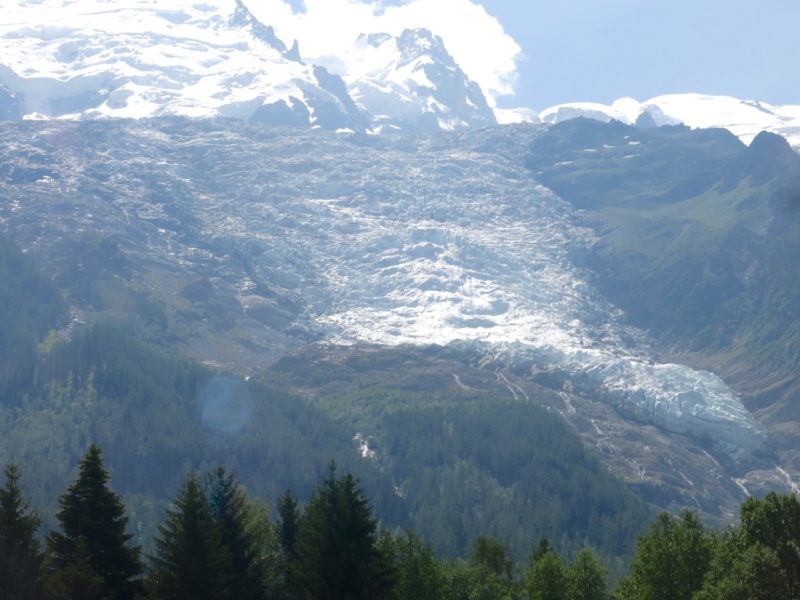
Bossons glacier, Chamonix Valley (library picture). Image © PlanetSKI
“Conditions in the high mountains are deteriorating day by day,” said the Chamonix Association for Prevention and Safety in the Mountains.
“Overnight refreezing is almost non-existent up to 4,000m, and several snow bridge collapses have been reported in the last 24 hours.”
The organisation strongly recommend that mountaineers stick to secure rock routes.
The heatwave has created highly unstable conditions on Mont Blanc routes.
Mountain guides and alpinists at the Aiguille du Midi gateway report that structural melting has caused snow bridges to soften, glacial crevices to rapidly widen, and massive ice ridges to collapse down steep slopes as the high-altitude snowpack fails to refreeze overnight.
The atmospheric pressure has also compromised emergency operations with the PGHM high-mountain gendarmerie rescue service sheding equipment weight and running extra helicopter rotations in the thin, heated mountain air.
As temperatures in the valley hub of Chamonix hit 34°C, meteorologists warn that it is due to long-term climate change that is transforming the landscape of Europe’s highest peaks.
Much of northern and southern Switzerland is on maximum weather alert with MeteoSuisse, warning of a “significant drought situation”.
Switzerland broke the record for its hottest-ever June day for the third day in a row on Saturday, with the mercury rising to 39C in the northern city of Basel.
There have been several heatwaves in Switzerland lasting several days in June in the recent past.
These include 2017, 2019, 2022 and 2025.
The first heatwave in May hit the glaciers hard, though it came after good Spring snowfall.
The rising temperatures are being driven by hot air moving north from the Sahara desert in Africa.
This traps hot air over the affected areas, with forecasters suggesting the conditions could result in one of the longest heatwaves in recent years.
Scientists have said that recurring heatwaves are a marker of global warming.
Météo-France notes that of the 51 heatwaves recorded in France since 1947, 34 have taken place since 2000 and 26 since 2011.
The Alps and the Pyrenees are affected.
Climate change is driving up temperatures around the world, but particularly in Europe.
It is the fastest warming content, heating up twice as fast as the global average, according to the Copernicus climate service.
This is due to a range of factors including the rapid heating of the Arctic, and changes in the pattern of the jet stream.
Scientists from the World Weather Attribution say a heatwave of this magnitude so early in the summer would have been virtually impossible 50 years ago.
They say climate change is “unequivocally” to blame.
It is causing increased summer heatwaves that melts the glaciers.
Some ski resorts are now actively promoting themselves as the place to head for in the summer to stay cool.
One destination trying to meet the growing demand for “coolcations” is Meribel in the French Alps, where summer temperatures typically remain a comfortable 18–23°C.
“Nestled in the heart of the Three Valleys at 1,450m, Meribel offers visitors the opportunity to swap crowded beaches and sweltering cities for mountain trails, alpine lakes and wide-open landscapes,” a statement from Meribel.
“While much of Europe bakes in soaring temperatures, the resort’s higher altitude provides a refreshing alternative, making it an ideal destination for families, couples and outdoor enthusiasts looking to swap crowded beaches and sweltering cities for alpine meadows, mountain lakes and fresh mountain air.”
See our related article on where skiing and snowboarding is on offer this summer:

Summer skiing in Val d’Isere. Image © Olivia Angus/PlanetSKI
Here at PlanetSKI we will be updating shortly once the impact of the heatwave becomes clearer on the currently open glacier ski areas.
Do check back….
PlanetSKI: Number 1 for digital ski news
Your digital platform for ski news, resort information, travel, equipment rental, sport, money saving deals and everything connected with snowsports – web site, social media & more.