



Another Heatwave Hits the Alps with Damage to Glaciers & Mountains
9th August 2026
Last modified on August 16th, 2026
Another heatwave is underway with summer skiing all but over. Two refuges on Mt Blanc have been shut due to threat of rockfalls, glacier melt accelerates with low river levels. UPDATED
The latest heatwave has destabilised mountains further and increased the risk of rockfalls.
All the refuges on the normal climbing route up Mont Blanc have been closed.
The mayor of St Gervais has ordered the closures of Gouter, which takes up to 120 alpimists during summer and Tête Rousse which can accommodate 74 people.
The last time such measures were taken was in 2022.
Falling rocks killed two Czech climbers several weeks ago and the terrain is judged to have become more unstable.
“The period of drought we are going through means that the practice of mountaineering requires particular vigilance,” said the Mayor of St Gervais, Jean-Marc Peillex.
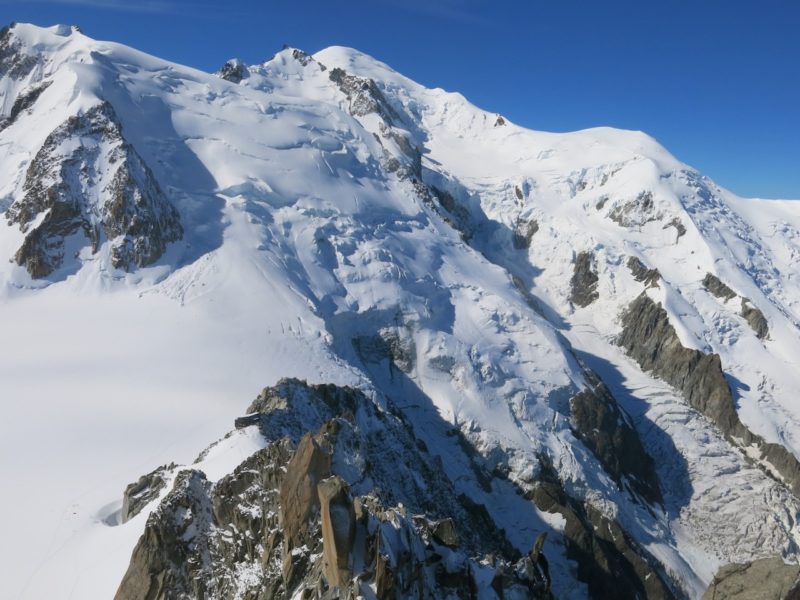
Mont Blanc, France. Image © PlanetSKI
Videos have been posted on social media showing a major landslide that occurred at the end of last week in the Snack Couloir .
Climbers & hikers have been warned of dangerous conditions across many parts of the Alps with dry glaciers, weak snow bridges, and open crevasses at altitude
“It is up to all climbers, whether accompanied by guides or not, to fully grasp the gravity of the situation and abandon their climbing plans for the duration of this crisis,” added Mayor Peillex of the situation in the Mont Blanc Massif.

Mont Blanc Massif, France. Image © PlanetSKI
Climbing routes have been closed on the Italian and Swiss side of the Matterhorn due to the dangers of rockfall as we reported earlier on PlanetSKI:
The ice tunnel that has been used by generations of mountaineers out of the Aiguille du Midi cable car top station and onto the high ridge above Chamonix no longer exists.
The authorities have been trying to stabilise it, but now the tunnel has been dismantled.
It ends one of the most iconic mountaineering access points in the Alps.
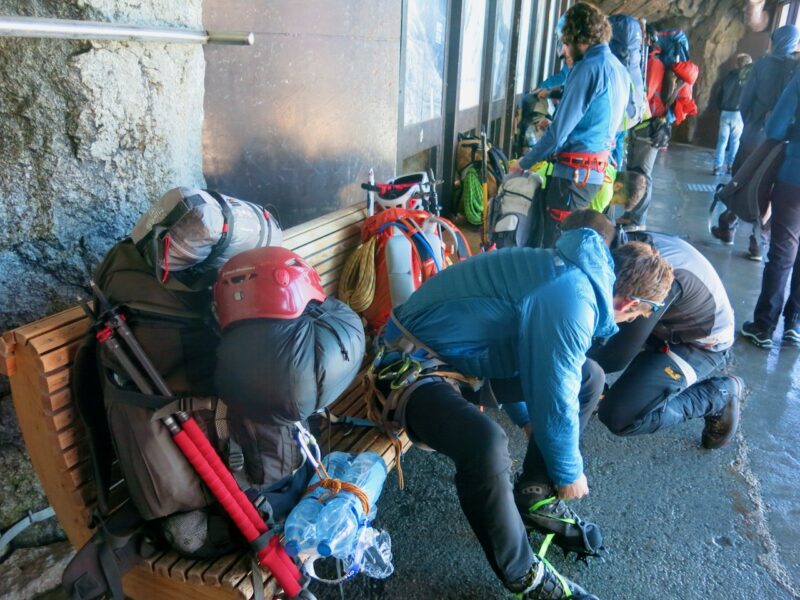
Mountaineers preparing at the Aiguille du Midi. Image © PlanetSKI
We have reported on the impact on summer skiing, hiking and climbing in an earlier PlanetSKI article as the Swiss resort of Saas-Fee closed its glacier skiing area on Monday 10th August:

Image c/o Saas-Fee, Friday 7th August.
Only one resorts remains open for summer skiing, Passo Stelvio in Italy, but it only has 3km of slopes open.
The longer-term impact on the heatwaves of the summer of 2026 is on the glaciers themselves.
Glaciers in Switzerland have lost 24% of their volume between 2015 and 2025, according to the group Glacier Monitoring in Switzerland, GLAMOS.
The Rhône Glacier has lost more than four metres of ice in just one month after two periods of extreme heat in June and July.
According to Switzerland’s Glacier Monitoring Service the glacier has been melting at an average rate of around 10cms a day, with low winter snowfall leaving the ice especially vulnerable.
The Rhône Glacier in southern Switzerland has lost more than 4m of ice in a single month after successive heatwaves swept across Europe.
It highlights the growing impact of rising temperatures on Alpine glaciers.
Glaciologists say the combination of low winter snowfall and unusually high temperatures has left the ice exposed and vulnerable.
It raises concerns that 2026 could rival the record glacier losses recorded in 2022.
Researchers monitoring the site say the glacier is not only melting at the surface but also from below.
Flowing meltwater is carving out large cavities that weaken the ice from within.

Rhône Glacier. Image © ETH Zurich Chair of Glaciology
“This is a collapsing pit,” said the glaciologist and head of GLAMOS, Matthias Huss.
“The stream flowing beneath the glacier has carved out a large cavity.
“This cavity then collapsed.
“In recent years, we have been seeing more and more cases of glaciers melting from below, in addition to melting from above.
“These processes are eroding the glaciers from within.
“This is a major problem that is further accelerating the melting.”
The rapid retreat is transforming the landscape, with the lower sections of the Rhône Glacier expected to disappear within years if current trends continue.
“With these high melting rates, the glacier is retreating very rapidly,” Mattias Huss added.
“I think that in this area, there will be no more ice within 5 to 10 years.
“The glacier will only remain higher up on the mountain, where it’s colder and there’s more snow.”
Dr Lander van Tricht, glaciologist at the Swiss Federal Institute of Technology, said in recent years climate change has led to “much less snow in winter and much, much more melt in summer.”
Scientists say this year’s poor conditions began before the summer heat.
Below-average winter snowfall left glaciers without the protective snow cover that normally slows melting.
Then there were summer heatwaves in May, June, July and August across the Alps.

Grande Motte glacier, Tignes. August 2026. Image c/o David Morgan.
Images from space show the scale of the glacier melt elsewhere in the Alps.
The Adamello Glacier is the largest in the Italian Alps and sits on the plateau of Pian di Neve between Lombardy and Trentino.
The 2025–2026 winter brought little snow to the massif, exposing the glacier surface to solar radiation earlier than usual.
Conditions are deteriorating further during the heatwaves of summer 2026.
The freezing level rose to almost 5,000m, well above the highest summits, and the ice continued to melt even at night.
These Copernicus Sentinel-2 images, were taken on 7th August 2016 and 5th August 2026.

Credit: European Union, Copernicus Sentinel-2 imagery
The image on the left shows a broad, continuous ice cover, bright white under late-summer snow.
In contrast, the image on the right reveals a darker surface of bare, debris-marked ice in pale grey tones, with the body of the glacier fully exposed.
Between the two acquisitions, the front of the Mandrone tongue, the glacier’s main outlet, has retreated by around 550m, according to the Italian Glaciological Foundation.
The largest glacier in Austria, the Pasterze glacier, continues to disappear at an accelerating rate.
Scientists warn it is likely to split into two sections this year as Europe’s heatwaves accelerate the melting.
Over the last 30 years the ice connecting the glacier’s lower and upper sections has melted away.
In the 1990s, it was nearly 300 meters thick.
Today, it’s barely visible beneath the gravel and sediment.
Extreme heat is accelerating that process, splitting the Pasterze in two and ending its position as Austria’s largest glacier.
Summer in the Alps is now not only hotter, but it is longer.
Twenty years ago, glacial melt was largely confined to July and August.
Now it can last from May through November, with up to 15cms of ice disappearing every snow-free day.
Sand from the Sahara has also been playing its part in glacier melt in the Alps.
Mineral particles carried by the wind fall on the glaciers and reduce the snow’s ability to reflect sunlight, accelerating glacier retreat.
A study conducted on the Argentière Glacier in the Mont Blanc Massif shows that these dust deposits accounted for 9 to 15% of summer melt between 2019 and 2022.
In some areas of the glacier, their contribution reached nearly 25%.
The heatwaves have also affected river and lake levels.
In Switzerland rivers and streams have seen exceptionally low water levels due to the ongoing drought.
In July, the Federal Office for the Environment, FOEN, even recorded historic lows at eleven monitoring stations.
According to the FOEN, water levels in many watercourses north of the Alps are so low that this only occurs once every two to ten years, and in some cases only once every 30 to 100 years or even less frequently.
South of the Alps, the situation is less dramatic, partly thanks to glacial melt.
Water levels in numerous lakes are also exceptionally low, including Lake Constance, Lake Walen, Lake Zurich, Lake Zug and Lake Maggiore.
Smaller lakes have also been affected.
The FOEN emphasises that Switzerland still has “abundant water resources”.
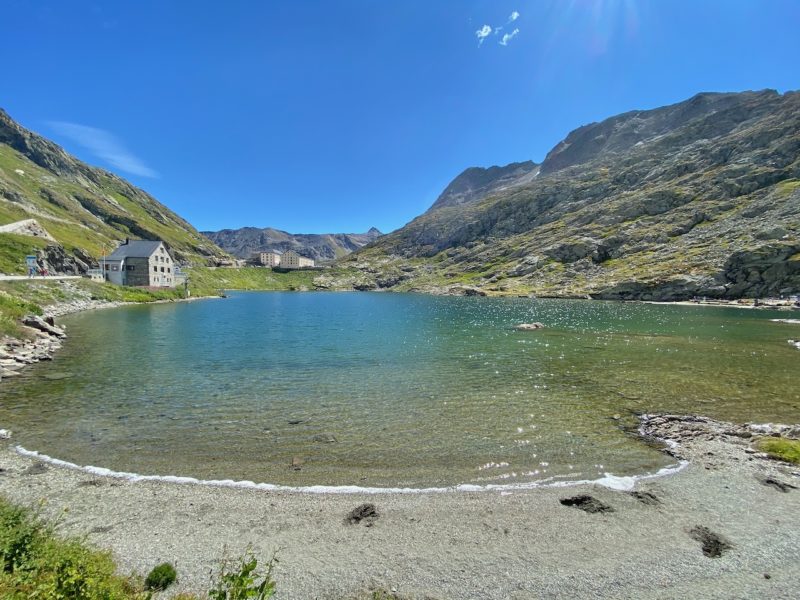
St Bernard Pass. Image © PlanetSKI.
The total volume of water available over the course of the year is expected to decline only slightly.
However, climate change will alter their availability: the water supply from snowmelt and glacial melt is decreasing.
Dry spells are likely to become more frequent and longer, with more water in winter and less in summer.
The current hot weather in the Alps and the Pyrenees peaks on Thursday with temperatures decreasing over the weekend.
Next week is forecast to be cooler.
Related Articles:
- European heatwave hit the glaciers in the Alps
- European heatwave hits glaciers hard
- ‘Glacier Loss Day’ in the Alps reached
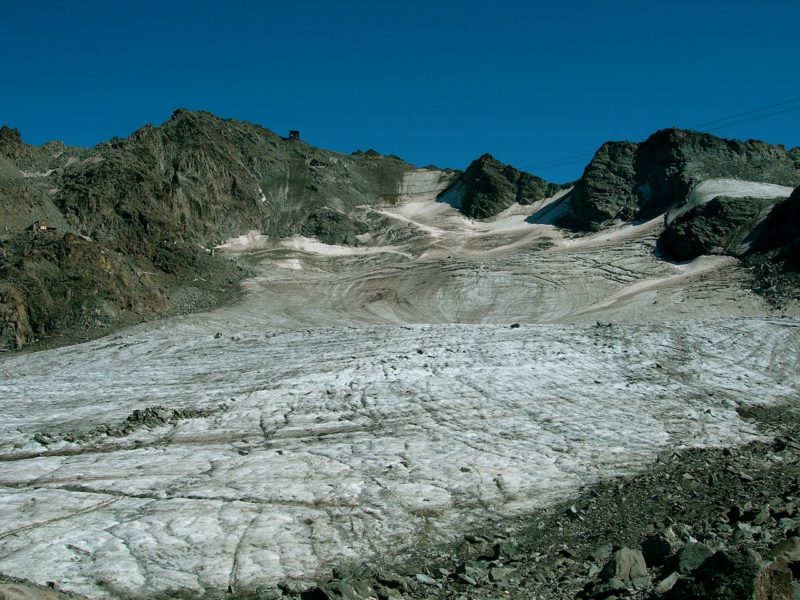
Mont Fort glacier, Verbier. Image © PlanetSKI
PlanetSKI: Number 1 for digital ski news
Your digital platform for ski news, resort information, travel, equipment rental, sport, money saving deals and everything connected with snowsports – web site, social media & more.